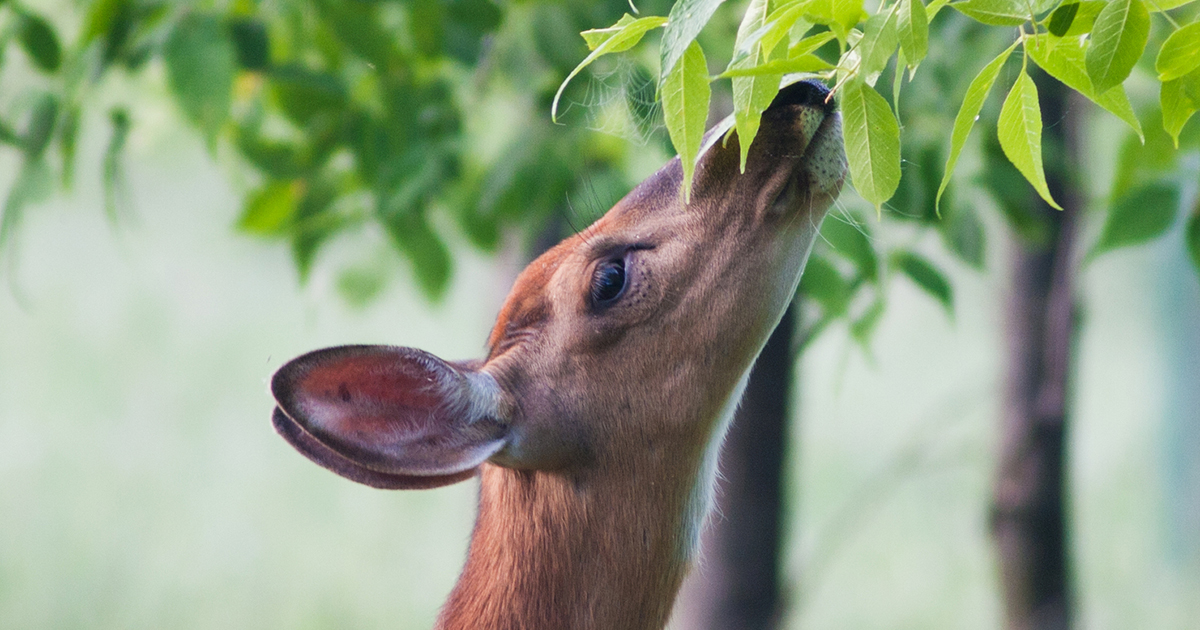
Ontario has some huge deer. Of the 30 subspecies of whitetails in North America, ours is the largest. Odocoileus virginianus, subspecies borealis (of the north), is found from Manitoba east to the Maritimes and in bordering American states. Though other northern jurisdictions might have recorded larger individual deer, available data shows that average weights of Ontario deer, and particularly those from northwestern Ontario, could be the highest in North America. Body size becomes progressively smaller as you move the south. Southern Florida key deer, for instance, are not much bigger than a medium-sized dog. And, even though many Canadian prairie and Texas deer sport huge antlers, body sizes are comparatively small. Live or “round” weights are difficult to come by; most hunter-killed deer are eviscerated as quickly as possible to avoid spoilage. Full body weights are available mainly from research studies and occasionally from traffic kills. Accurate weights of large samples of field-dressed deer were taken decades ago by Ontario game managers and researchers. Field-dressed (eviscerated) weights of northwestern Ontario and east-central Ontario deer are listed in Table 1. Determining Deer Weight Large or small, a deer loses an average of 23% of its body weight when field dressed, and another 17 to 25% when hide, head, and lower legs are removed. This butcher-ready weight is a higher percentage of whole body weight for larger animals. For instance, an 80-pound field-dressed fawn fully dresses (butcher ready) at 52%; a 125-pound yearling at 57%; and a field-dressed deer over 160 pounds at about 60%. The relationship between field-dressed, hanging butcher-ready, and live weight is also shown on an accompanying graph (see table 2). This graph, prepared from data produced by Michigan, New York, and Ontario wildlife researchers,provides estimates within about five pounds of live, field-dressed, and butcher-ready weights. If youknow one weight, the other two can be determined. For example, if a buck weighed 200 pounds fielddressed, it would weigh about 260 pounds live, and 156 pounds at the butcher’s.Here’s a quick calculation to determine approximate live weight: multiply field-dressed weight by1.3. For instance, 200 pounds dressed times 1.3 equals 260 pounds live weight, which a quick lookat the chart will confirm. To simplify matters, all weights are in pounds; metric users can multiply by2.205 to convert the figures to kilograms. Record Weights For Ontario, solid information is scarce. Neither the Ministry of Natural Resources and Forestry (MNRF) nor the Ontario