
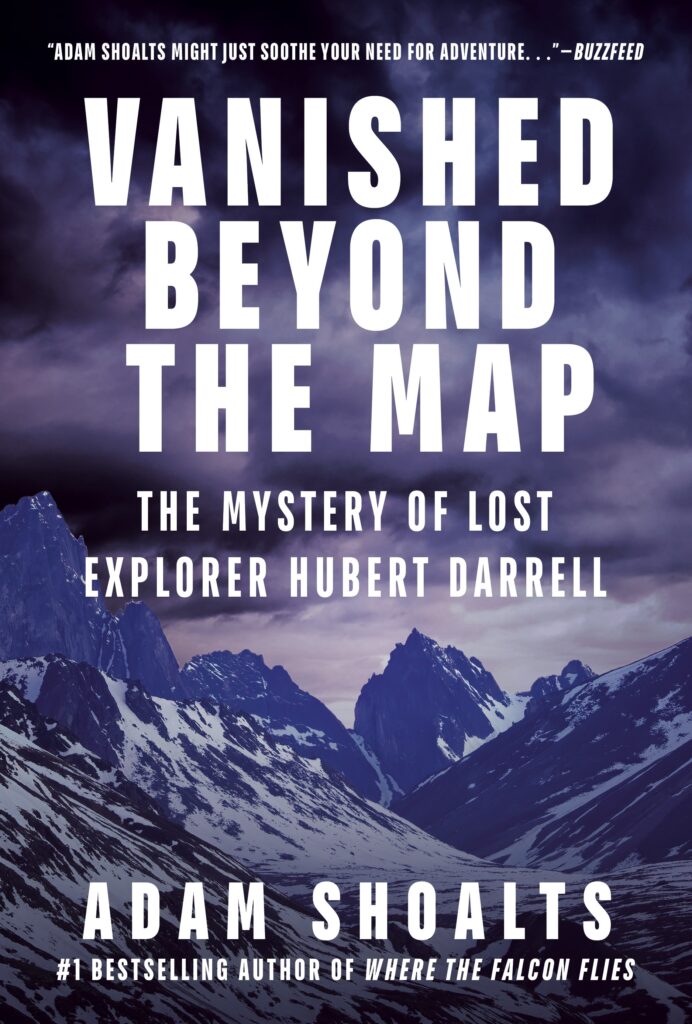
Explorer, writer, and public speaker Adam Shoalts grew up in the swampy forests of Fenwick, where he learned bushcraft from his woodworker father. This author of six national bestsellers has led Royal Canadian Geographical Society expeditions, tracks endangered species, and completed a nearly 4,000-kilometre solo journey across the Canadian Arctic in 2017. Shoalts’ latest book, Vanished Beyond the Map: The Mystery of Lost Explorer Hubert Darrell, was released in October.
We learn more about the Norfolk adventurer, geographer, and historian in these responses to questions from Ontario Out of Doors.
OOD: You mentioned previously that you read OOD as a kid when you and your brother were really into fishing. Do you still fish now?
AS: Yes, I still love fishing. Mostly I fish on my wilderness journeys. But I’m also lucky enough to live in a place where I have a spring-fed stream with native brook trout right in my backyard.
OOD: We read somewhere that you don’t hunt. Can you offer any insight into that?
AS: When you’re alone for months, your only company is sometimes wildlife. That said, if I was hungry, I wouldn’t hesitate too much to help myself to a ptarmigan or grouse.
OOD: In your online bio, it states your father taught you about trees. What is your favourite item you’ve crafted from the forest?
AS: Probably our canoes. It’s a very satisfying feeling to travel in a canoe you built yourself, and building a birchbark canoe from scratch with just material obtained in the forest around my home was a very neat experience.
OOD: You’ve spoken about the importance of preserving wild places and have been involved with many conservation organizations. What does conservation mean to you?
AS: It means many things: but ultimately, I think we’re all better off when we’re able to have forests, fields, and wetlands on our doorsteps or as near to them as possible. A country with an abundance of wild places makes for a much better place to live than one that has paved them all over.
OOD: You’ve been called Canada’s Indiana Jones. How do you respond to that?
AS: I just laugh. It was the Toronto Star that named me that back in 2013. It was funny because really my personality is nothing at all like Indiana Jones. I’m an archaeologist and I do adventures, but I think the similarities end there. On the other hand, he is of course an adventure icon, so I’m flattered by the comparison.
OOD: In 2022, you were presented with the Louie Kamookak Medal for “making Canada better known to Canadians and the world” by Chief Perry Bellegarde, former National chief of the assembly of First Nations and President of the Royal Canadian Geographical Society. What did that mean to you?
AS: It’s always nice to receive recognition for one’s work. But ultimately that is not why I do it. The most satisfying thing to me is simply doing what I love out in the wild. I try to share a little of that in my books, and if other people enjoy them, that is a nice thought and something that I’m grateful for.
OOD: Your research has combined your interests in nature, history, archaeology, and geography. What’s something you’re into that people might not know?
AS: Hmm…my actual academic speciality is Viking archaeology and the Greenlandic Viking voyages. I do a lot of work on that behind the scenes. I’ll write a book on it eventually.
OOD: Some of your adventures have seen you go months without human contact. What’s the hardest part about that?
AS: Solitude can actually be very relaxing, and to be able to get away from the hustle and bustle of the fast-growing modern world into the wilderness is mostly a wonderful feeling. Of course, it’s true that on your own you have to do twice as much work since there is no one to share it with: all the paddling, firewood gathering, setting up and breaking camp, etc. But I don’t mind that. However, I would say that now that I’m a parent to three little boys, it’s much harder to have to be away for long stretches: but ultimately, it’s how I earn a living. And if you do have to be away, it just makes when you’re together all the more special and meaningful: you make every moment count for extra.
OOD: What’s the coolest thing you’ve come across in the wilderness?
AS: My most recent expedition was a quest to retrace the route of a legendary lost explorer named Hubert Darrell who disappeared in the Arctic more than a century ago. Finding traces of his last camp and unravelling what had really happened to him was a pretty cool experience.
OOD: If you could go on any expedition, from the past to the foreseeable future, where would you go, and why?
AS: I’ve been lucky enough to have done most of the big adventures I dreamed up: a nearly 4,000 kilometre solo journey across Canada’s Arctic by canoe, another 3,400 km journey by canoe starting from Lake Erie all the way up to the Arctic, and many shorter ones such as crossing the Hudson Bay Lowlands, looking for ruins of old fur trading posts, or trekking across Arctic islands. So really, I can’t answer the question because I never know what my next adventure might be. Usually I see something that inspires me, like a falcon soaring out my window, and before I know it, I’m off on a new journey.
OOD: Who or what do you enjoy reading?
AS: I mostly read historical records, many of them unpublished, such as the journals of past explorers, fur trapper’s diaries, and ship’s logbooks. These are the records I used as research for writing many of my books, such as A History of Canada in 10 Maps or The Whisper on the Night Wind.
OOD: If you could change one thing about today’s natural environment, what would it be?
AS: Definitely I wish we could protect more wilderness, and I wish we could undo the loss of so many individual tree species. For example, all the ash trees that we have lost to the emerald ash borer in recent years, or before that, the tragic loss of elm trees from Dutch elm disease, or even worse, the almost total extinction of mature American chestnuts, which were once the kings of the eastern forest. One of my greatest discoveries I ever made was finding a large American chestnut in the woods. 99.9% of them were killed off by the invasive chestnut blight accidentally introduced in 1904. Now, we’re rapidly losing beech trees and hemlocks to invasive species. Personally, I love the woods, so losing much of the variety of trees that give the forests their charm and colour, is a tragedy. On the other hand, I remain an optimist, and I think that if we can find the will, we can save many of these species.
Favourite explorer?
Alexander Mackenzie and Samuel de Champlain (see my book A History of Canada in 10 Maps for why). Among lesser known figures, definitely Hubert Darrell (see my book Vanished Beyond the Map for why).
Least favourite biting insect?
Deerflies
Favourite fish to eat?
Brook trout
Spinning or baitcasting?
Spinning
Favourite lure or bait?
A small spoon, silver and orange, from Lucky Strike. (It was the only lure I used for my entire 3,400-kilometre journey from Lake Erie to the Arctic and I caught a brook trout on almost every cast.)
Leafs or Sabres?
Habs. (Sorry).
Northern Ontario or Canadian Arctic?
Both. (I love the remoteness and wildness of the Arctic, but I love forests too, so northern Ontario is also special).
Originally published in the Jan.-Dec. 2026 issue of Ontario Out of Doors