The province's largest and longest-lived fish species, the lake — or rock — sturgeon, is known by many names.
Acipenser fulvescens, Name and Nme (Ojibwe), and Nameau (Cree), all refer to this freshwater giant, which has been recorded to live more than 150 years. The oldest-known specimen, from Lake Huron, was aged at 155 — nearly as old as Canada itself.
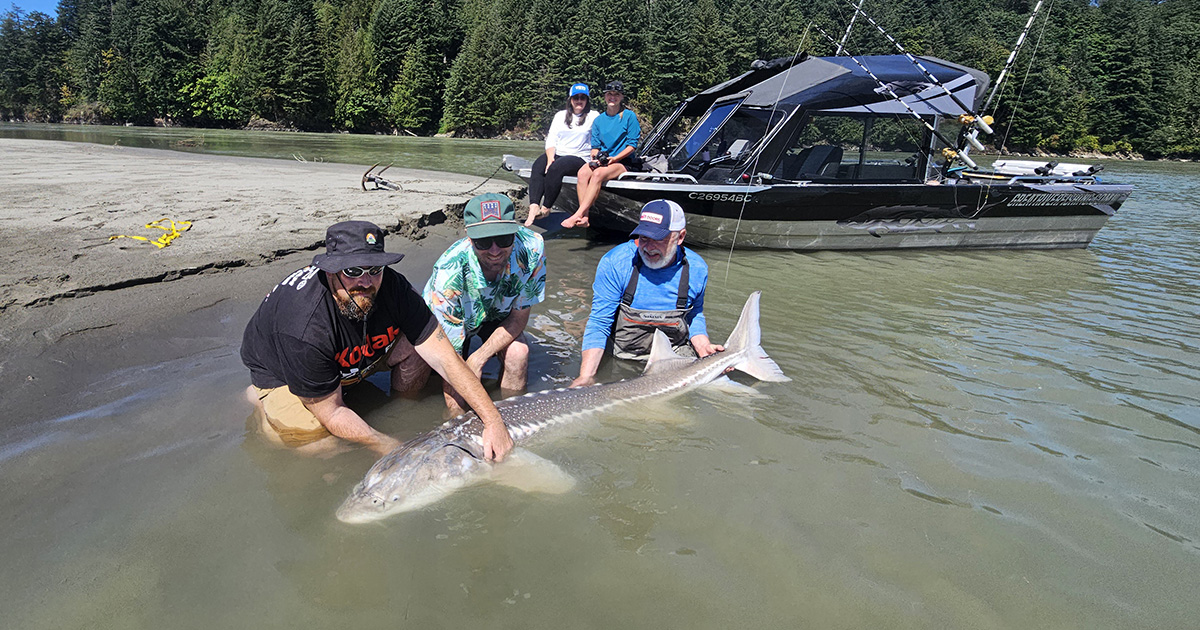
While describing the life of a sturgeon in human years is helpful, knowing geological eras is necessary to understand the origins of this incredible fish, which traces back to the Triassic period more than 200 million years ago. These bottom-feeders typically range between three and five feet long and weigh between 10 and 80 pounds, though some have exceeded seven feet and 200 pounds.
Sturgeon have cartilaginous skeletons, skin rather than scales, external bony scutes along their body, and a pointed snout with four distinct barbels that help sense the environment and locate food. Propelled by their heterocercal tails — the top lobe is larger than the bottom — sturgeon use ventral mouths to suck up preferred forage such as insect larvae, crayfish, and molluscs. Like Great Lakes salmonids, sturgeon are potamodromous, meaning they migrate but live exclusively in freshwater.
These fish have long been both a vital food source and subject of immense spiritual and cultural significance for Indigenous Peoples. Skins were used as containers, scutes as grinding tools, and backbones as arrowheads. Many First Nations communities regard sturgeon as sacred, attributing to them otherworldly powers. The species once brought together large gatherings of people to harvest and celebrate them, and they continue to be deeply appreciated today.
Populations declined
The more recent history for sturgeon has been turbulent, just like all eight species of North American sturgeons. Once considered a scourge by commercial fishers because of the damage inflicted on fishing nets, sturgeon were routinely killed and dumped back into lakes, piled on shorelines and burned, fed to livestock, or used as fertilizer.
It wasn’t until the 1860s that attitudes began to shift toward valuing their flesh and, especially, their eggs (caviar). Sturgeon were also harvested for isinglass, a protein derived from the swim bladder that was used to produce gelatin for baking and as a clarifying agent in beer and wine production.
Between the mid-1800s and early 1900s, millions of kilograms of sturgeon were harvested, which, along with other factors, lead to a dramatic population decline across their range.
Despite these adversities — which now also include invasive species and climate change — sturgeon have persisted and inhabit at least 229 Ontario waterbodies. In 2009, the species was divided into distinct populations, and today the Great Lakes–Upper St. Lawrence population is listed as endangered (reassessed in 2017), the Saskatchewan–Nelson River population is listed as threatened, and the Southern Hudson Bay–James Bay population is listed as special concern.
Draft plan was derailed
While sturgeon fishing today is limited, prior to July 1, 2008, most zones (or the former divisions) had angling rules that even permitted harvest.
In 2008, all sturgeon seasons were converted to catch-and-release only, and the province committed to developing a management plan along- side stakeholders like the Ontario Federation of Anglers and Hunters (OFAH).
Unfortunately, public consultation on a draft was abruptly derailed due to species at risk designations that protected the Great Lakes–Upper St. Lawrence and Saskatchewan–Nelson River populations.
The province has gone on record stating that angling-induced mortality is not a significant factor for sturgeon, yet anglers have been largely removed from the equation across most of Ontario.
Dr. John Casselman, adjunct professor at Queen’s University, once said, “To catch, handle, and carefully release a sturgeon… reinforces why anglers who handle fish can be the very best custodians and conservators of Ontario fish and fish resources. To handle one of these fascinating creatures is to want to ensure their persistence and to pass on this unique experience to others.”
The OFAH continues to advocate for sturgeon conservation and sustainable fishing opportunities in the parts of the province that can support them.
Definitions
- Special concern means a species could become threatened or endangered due to biological characteristics and identified threats.
- Threatened means likely to become endangered if steps are not taken to address factors threatening the species.
- Endangered means facing imminent extinction or extirpation.
Lake Sturgeon fishing in Ontario is allowed only within the Hudson Bay–James Bay population, which includes Fisheries Management Zones (FMZs) 1, 2, 3, and 8. These zones have catch-and-release seasons from January 1 to April 30 (April 15 for Zone 3) and from July 1 to December 31.
Originally published in the Ontario Out of Doors Fishing Annual 2026
Click here for more outdoors news
Watch on-demand videos anytime on OFAH Stream