
Burbot seem to be having their moment in the world of ice fishing. Each winter, an increasing number of Ontario anglers head out to target these fascinating fish. But what about the open water? You simply don’t hear much about anglers targeting burbot during the spring, summer, or fall.
I’ve spent the last several years combing through research, spending nights on Ontario’s inland lakes, and chatting with a select few in an attempt to figure out these strange fish and, although there is still plenty to learn, I’m happy to report that catching burbot during the open water season is very possible indeed.
Burbot are a cold-water species with a preference for water temperatures below 13˚C and an aversion to light. While cool temperatures and ice cover allow them to stay active all day during winter, most burbot activity takes place in darkness. During the day, at least in the open-water season, these fish dwell mostly in the cold, deep, and very often soft-bottomed portions of a given waterbody. For most of Ontario’s inland lakes, this puts them somewhere between 60 and, say, 120 feet during the day. Throughout the Great Lakes, on the other hand, their daytime haunts could be much, much deeper — they’ve been recorded as deep as 980 feet in Lake Superior.
As the sun sets, many burbot begin what’s called diel bank migration, a bottom-oriented transition from deep to shallower water. Just how shallow this is depends on light conditions, time of year, forage, and even individual fish behaviour, but the general trend is a transition to warmer, food-abundant waters. In a telemetry study of burbot in Algonquin’s Lake Opeongo, some individual fish were recorded going as shallow as 10 feet during the heat of the summer, spending several hours in waters of 20˚C and hotter. Overall, though, research and personal experience suggests that open water burbot fish spend most of their nights cruising in and around the thermocline.
To find fish, I look for gravel slopes and flats, rocky shoals, and main-lake points in the 40- to 50-foot range, dropping off into deep water. Although it’s not strictly necessary, I aim to be on the water for sunset. During this time of the day, called the crepuscular period, burbot activity picks right up as they begin to ease out of their daytime haunts, often staging just below that steep drop-off. This is likely your best chance to catch one of these fish when there’s still some daylight, so try fishing just inside the deep bowl or along the bank itself.
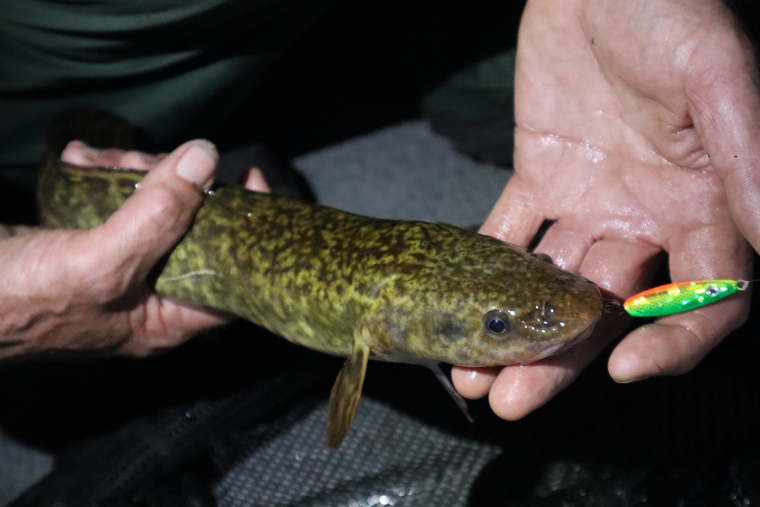
As the night wears on, you can work your way up to the shallower water. Although fish come and go through a great variety of depths during the night, some research suggests that the biggest fish have a tendency to go shallowest.
Burbot aren’t known for their eyesight. To find food, they rely on an especially sensitive lateral line and what is likely an acute sense of smell, making noisy lures like Northland Tackle Buckshot or Sebile’s Vibrato ideal. Tip these with a dead minnow or three and you’re in business. Alternatively, the classic glow-jig and minnow or a simple deadbait rig will have no trouble putting these captivating fish boatside.
Regardless of what’s on the end of your line, it’s important to make a racket when you’re targeting these fish. Burbot don’t school, strictly speaking, so you’ve really got to bring the fish to you, and there’s no better way to do that than by pounding bottom. Smash your lure off bottom for 30 seconds or so, then slow to a subtle jig or even a deadstick to seal the deal with any incoming fish. Burbot spend the majority of their time within a few feet of bottom, so keep your lure good and close to the lakebed.
As a fun, plentiful, and tasty freshwater fish, I’ve no doubt that burbot are only going to grow more popular in the years to come and that, at some point, all this attention is going to spill over into the open water. So, why not get ahead of the buzz and give open-water summertime burbot a try?
Some research suggests that in larger systems, burbot may behave differently. They may not, for example, place as much emphasis on moving shallow as their inland counterparts.
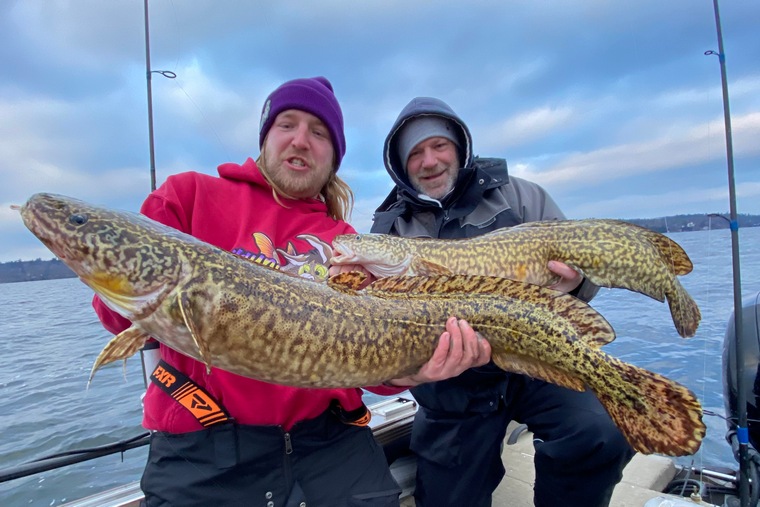
Tyler Brooks of Slaunch Donkey Guide Service and Lure Company has some experience catching open water burbot on the big lakes. On Lake Huron’s Georgian Bay, Brooks has begun targeting these fish in much deeper water at night.
“I think it’s really about finding where their primary summer structure is and then keying in on feeding areas,” he said. “Here on Georgian Bay, you’re looking for rock piles, gravel humps and shoals off your muddy areas, in the 150 range to as shallow as 80 feet.”
Originally published in the Fall 2024 issue of Ontario OUT of DOORS