
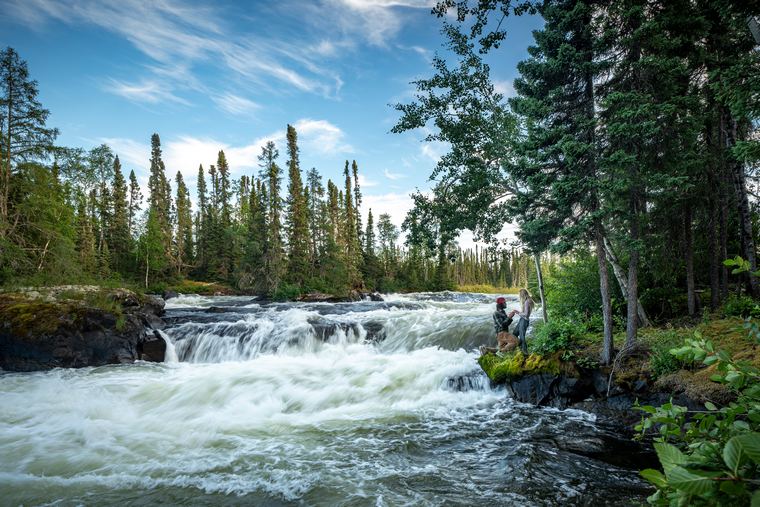
For days, the river had flowed against us — a steady, powerful current clawing at our legs as we waded upstream, guiding a yellow 17-foot canoe burdened with several months’ worth of food. The portages that once dotted this river some 75 years ago were gone. Now, we stayed half-submerged in the torrent, never losing hand contact with the canoe or letting our feet slip from the boulders hidden beneath the surface.
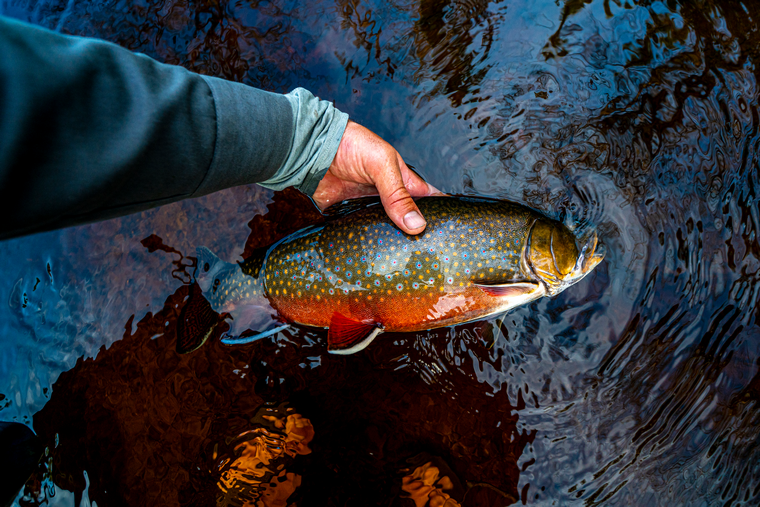
I noticed a flash in an eddy and suggested to Leah — my girlfriend of four years — that we wade to shore for a snack and a moment’s rest. Soon, I was locked in a cast-after-cast battle with the brook trout that make the Albany River watershed famous. With dinner secured, we waded back into the current and pressed onward. Hudson Bay — and another 1,000 kilometres of unforgiving terrain — wouldn’t wait.
The year was 2021. Leah and I were on a two-month canoe trip, traveling from just north of Lake Nipigon to Ontario’s northernmost community in the tidal waters of Hudson Bay-Fort Severn. When the weeks finally arrived where all water flowed downhill to the ocean — after escaping dry creek beds, wildfires breathing down our necks, eyes swollen shut from bugs, tough rivers, and the ever-present hunger that makes one first admire, then deeply respect, Indigenous peoples — we breathed a long sigh of relief. At a waterfall on the Fawn River, perhaps 500 kilometres from the ocean, I asked Leah to be us — to do this, forever, together — and she said yes. Weeks later, I’d wipe bugs from her sunken cheeks, urge her toward the tent, and stoke the fire a little higher as we traded night shifts on polar bear watch.
Beyond the kilometres and the quiet rewards of a long, hard trail, we found ourselves talking about the rivers we wished we’d had more time to enjoy. I longed for one more cast on that Albany tributary we’d had to leave behind. We began dreaming up a honeymoon for a wedding we had yet to plan. In those quiet moments — fearful, exhausted, satisfied, and hyper-focused — we were building a future in our minds, one rooted in the wild expanse of northern Ontario.
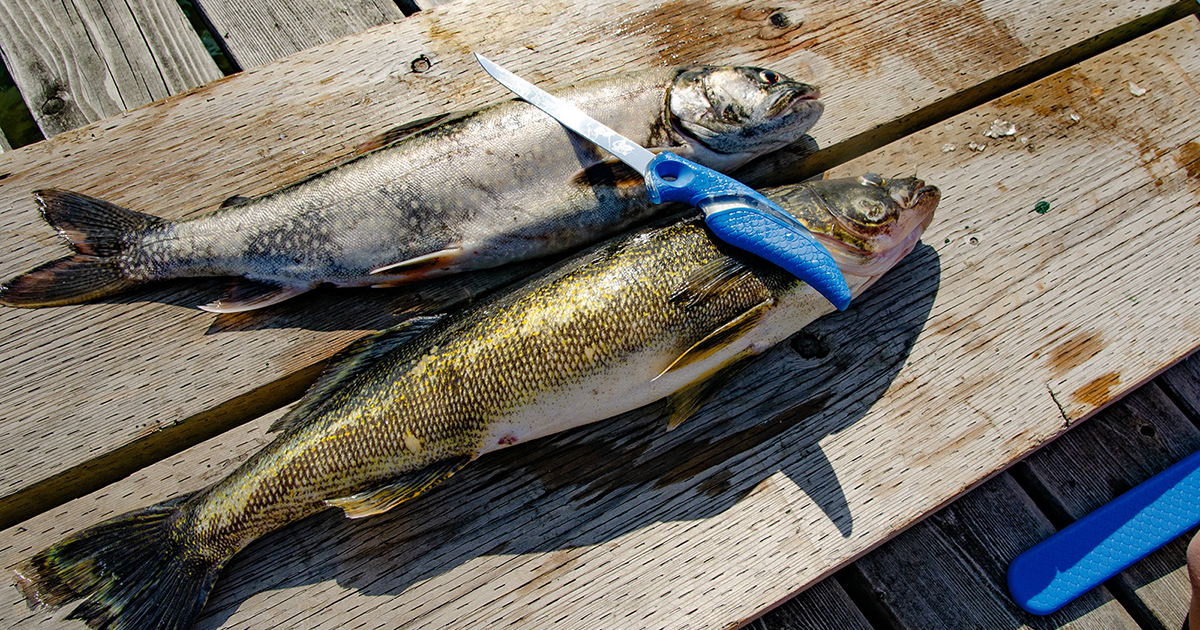
Leah and I grew up in different worlds, though in the same province — nearly 1,600 kilometres apart. At the end of the power lines, down a rough road that leads to some of the fishing northwestern Ontario is famous for, Leah grew up living the dream so many anglers and hunters hold dear. Her family’s freezer was full — of moose, mostly, but sometimes deer — and they fished. When you wanted to eat walleye, you went out and caught them.
Family photo albums tell the story: Leah and her siblings beside bull moose, their grandpa standing proud, her father and relatives straight-faced or smiling — a family tradition spanning generations. Turn the page, and you’ll find trucks parked on late-winter ice, grease hot in deep fryers, fish crisping under the March sun as the family gathers around, sharing stories. Or maybe the page is a collage of tents and trailers, a sun setting behind a sandy beach, a camping trip at one of the countless lakes just up the road from her family’s home.
I grew up in the hardwood forests of the Ottawa Valley — catching walleye in the spring, bass all summer, visiting deer camps in the fall, and borrowing my first beaver traps from my grandpa. Those early years, roaming the land where my mom was raised, shaped how I interpret vastness — a sense of freedom attached to a seemingly wild place. With the steady guidance of my parents, I slept outside alone before I was 10, learned to portage canoes, and how to stay safe on the little landlocked, red-pine ponds that surrounded our home.
When I started encountering wildlife, or coming home with fish stories, my dad handed me an early digital camera and challenged me to “prove it.” Soon, I was hooked — photography became a kid’s tool for deeper storytelling. I wouldn’t trade the vastness I felt growing up in the open forests of home. But when I met Leah, I realized how good life could be in the bush of northwestern Ontario — a land where fences are replaced by rivers, lakes, and swamps. A place where a person can still disappear into a labyrinth of land — the living North.
We met in 2017. I was five months into a canoe trip across Canada, paddling west to east, documenting Mike Ranta and his dog, Spitzii. My childhood dreams of becoming a trapper had evolved into a career in globe-trotting photojournalism, and this was my latest assignment. Ranta was attempting to solo-canoe across Canada for the third time via a new route, and I was along for the ride — in my own canoe.
As we neared Lake Superior, we paddled across Leah’s home lake. Her family welcomed us in for pizza and a sauna as evening closed in and we looked for a place to camp. That night, visiting with her family, I marveled at the different 30-inch monster walleye mounted on the wall and stood beneath the rack of a bull moose her father had taken — I figured they must have built the house around it. Their home was living proof of the northern legends I grew up hearing about down south. Leah and I kept in touch, and soon after that trip, I moved north.
It wasn’t technically our first date, but we always joke that it was — a 1,000-kilometre canoe trip from Sault Ste. Marie to Thunder Bay along Lake Superior’s rugged North Shore. It was our way of getting to know each other, to see what surfaced after three weeks in a canoe. Fortunately, we grew closer.
That winter, we bought a small woodstove and a lightweight canvas tent so we could keep exploring even as bitter cold took hold of the land. Weekend winter trips turned into week-long expeditions. Then, during a particularly grueling trek across several hundred kilometres of Quetico Provincial Park by snowshoe, we talked about paddling to Hudson Bay — and I quietly bought a small ring to bring on the journey. Leah drew a bull moose tag for our honeymoon — or honeymoose — and we still laugh at the memory of deboning, packing, and portaging that magnificent animal for three days by canoe to the nearest road.
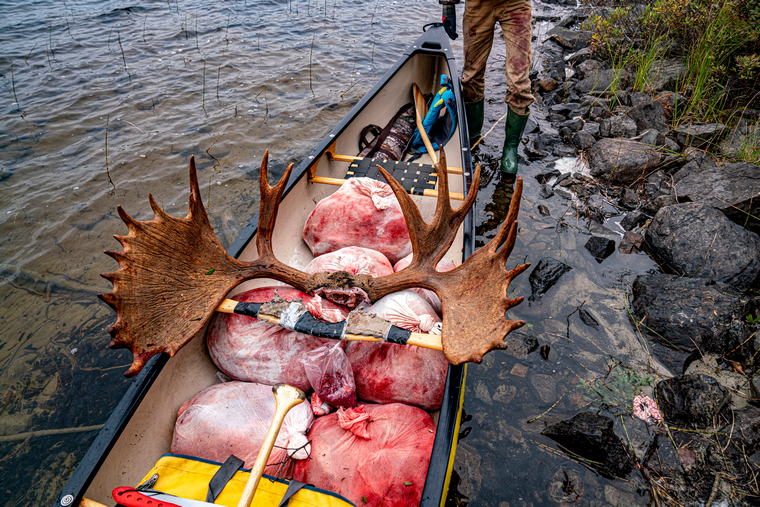
Fueled by game meat and wild adventure, our lives pulsed with energy. A month on the land no longer felt extreme — it felt normal. Places I once thought of as remote now felt like home. We started spending more time in our seasonal tents than at our actual home on Lake Superior’s North Shore, which we’d nicknamed Basecamp. Our summers were filled with tracing ancient 1,000-year-old portage trails that faintly braid the land, encountering woodland caribou at lakeshores, locking eyes with prowling wolverines, and hauling trout or walleye for dinner.
But everything changed one winter.
We were returning from a three-week camping trip and found ourselves crawling along a grim stretch of Highway 17 — northern Ontario’s harsh reality. A sideways whiteout closed in, and we couldn’t get off the road. Within moments, the drifting white world became a wall of steel and snow: a pile-up of transport trucks. We were lucky to crawl out Leah’s passenger door into a -35˚C freezer, luckier still to have our deep-winter kit within reach. That was the moment we knew: we needed a change — less time on the roads, more time on the land.
Five months later, Basecamp was far beyond our stern, replaced nightly by a red tunnel tent on the long trail north. We were chasing peace from the memories that haunted us and were quickly making friends with the bugs that besieged us. Instead of driving, we had carried our canoe a few hundred metres to Lake Superior, watching as our little town vanished in the ripples of our paddle strokes. Days later, paddling up the vast mirror of Lake Nipigon, I found myself locked in a battle with a big brook trout — a fish we desperately needed. Cursing our chronic neglect in never packing a net, I somehow landed the writhing trophy. It would be our last brookie for three months.
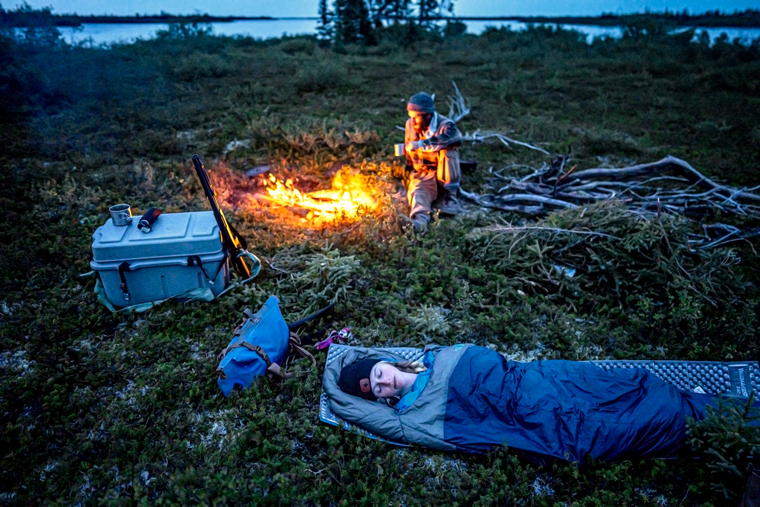
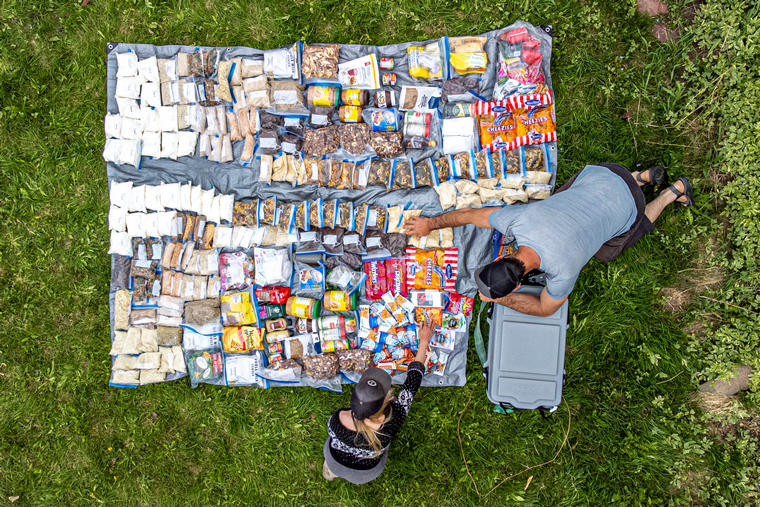
In our vow to drive less and make the world feel vast again, we had mapped a canoe route that would carry us to the northern Ontario train line. From there, we’d ride the rails west until a small railway dropped us near the Churchill River in Manitoba. Upstream we went, launching a 2,200-kilometre journey into the subarctic tundra of Nunavut. Movement became our medicine. The skills we’d honed over countless summers in northern Ontario were tested daily as we pushed farther north.
In Saskatchewan, burned hills and steep terrain replaced the portage trails we hoped to find. We feasted on walleye from the rapids. On lakes, we dropped a line only at dusk when a lake trout was needed. We limped into Reindeer Lake, only to be chased out by wildfires — smoke choking the air, our gear dusted in ash. Ancestral Cree trails led us into Wollaston Lake, where a rising threat of northeast winds kept us paddling through the night toward safety, chasing grey light before the storm could pin us down.
Cold, wet, and often windbound, we pressed on into the vastness where the trees thinned, and we began to feel tall. Hills stretched all around, making us feel small again. Early in our planning, Leah and I knew we’d need to resupply, and Kasba Lake Lodge had come to mind. If we could send food there, we’d also get to see our friend — wild-eyed fishing guide Mark Parr from Toronto — a thought that made us smile.
As storms gathered again, we raced down Kasba Lake. In a misty morning fog, a line of boats appeared from a bay. One veered toward us. At the helm was Parr, grinning ear to ear, his coffee-holding clients groggy as he ordered us to stay the night. He’d be back later.
One night became four as a relentless northeast gale battered the land. The Kasba family welcomed us like their own. Around late-night fires, we swapped stories with the guides. Parr grinned through tales of monster trout, a haze of summer light never fully fading in the northern sky. Leah and I aren’t diehard anglers, but we’re cut from the same cloth — bronzed cheeks, broad smiles, stories traded over fish dinners and firelight, carried with us down the long trail of life. We slipped away in the predawn darkness, cold rain at our backs, a sliver of good weather ahead — a reminder we weren’t even halfway to Hudson Bay. Another month passed, and so did the caribou.
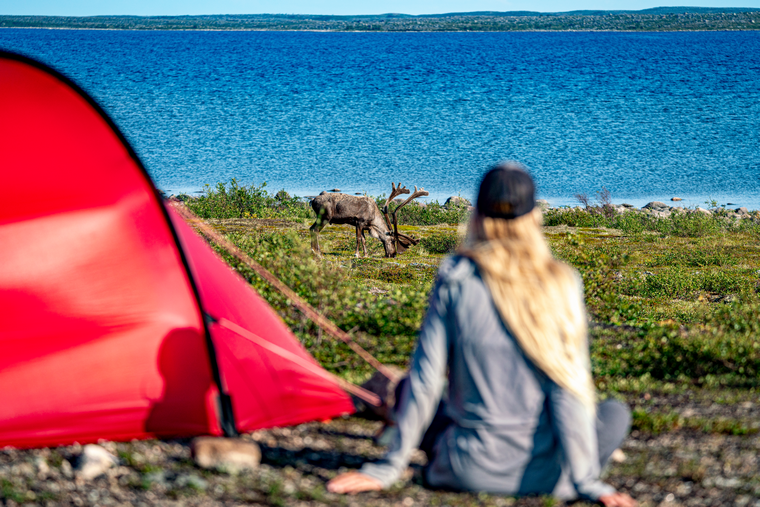
One river we paddled up, another down. There were no guidebooks where we went — only grit and a long-dreamed line drawn back at Basecamp. The land turned to stone, making portaging dangerous.
In clouds of blackflies, we stood in awe before ancient Dene and Inuit tent rings — perfect circles of stones, untouched for generations. A lone muskox grazed along the shore, keeping us company for awhile. At night, we gathered willow twigs to fry a pan of grayling, thankful for the fuel, the fight, and the flavor — even as we remembered the brook trout of home.
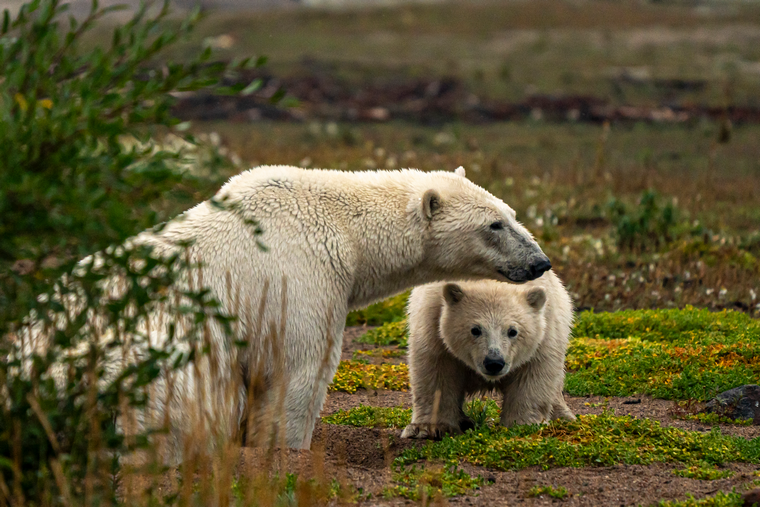
At last, we followed a wild river to the ocean. As the darkness of late summer returned, so did polar bear shifts, our nights filled with adrenaline and aurora. We back-paddled away from mothers and cubs perched like white boulders in churning rapids. On Hudson Bay’s coast, we hid in a spike-covered shack while bears gnawed at our canoes and stalked our every move. For days, we waited for calm seas. Then, finally, we spotted the bobbing hull of our shuttle driver on the horizon.
Paddling through beluga whales, we reached him and traded sea for steel — returning to the rails. We disembarked a few hundred kilometres north of home, in Ontario. That evening, Leah swam in front of camp when a boulder stood up — a bull moose in late-season velvet, aquatic greens trailing from his mouth. I landed a keeper brook trout. Three months earlier, we had watched woodland caribou swim in this very spot. Now, the fall wind returned, guiding us gently back to the little town we call home, along the shores of Superior.
Up to her knees in slightly clear but tannin-stained water, Leah’s rod arched hard into the river current that oozed by. Her braided line was taut, her left leg braced against a submerged log for footing, just upstream from a powerful rapid roaring into the afternoon. In front of her, the river ran like ink through the boreal. Leah squealed as the brook trout on her line launched from the water, scattering a spray of crystals in the sunlight.
Mid-battle, she called my attention to the water between her boots. Circling there, a giant, redbellied male brookie was pacing — hungry. We were in the heart of feeding frenzy on an Albany River tributary. She landed her fish — a solid one — then quickly let it go and dropped her spinner at her feet. The water exploded. Her drag screamed.
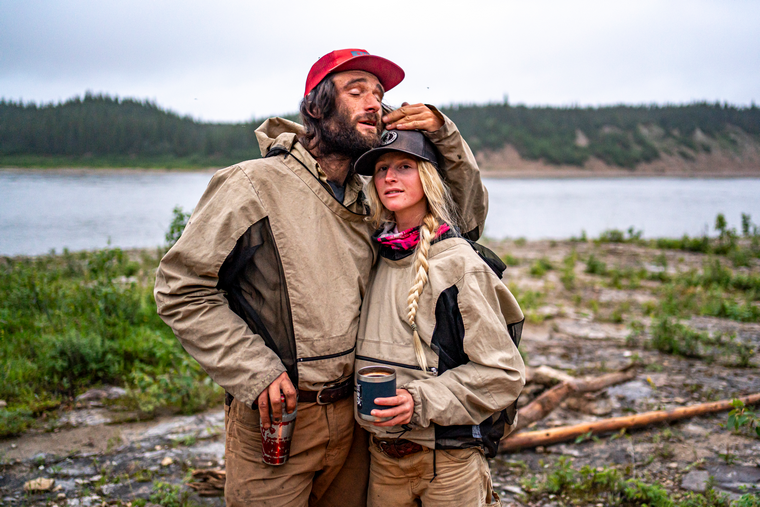
A year had passed since the tundra welcomed us in, and now we were exactly where we’d always dreamed — on a four-week, 500-kilometre circle route to the Albany and back. The water was high. The skies were smoke-free. The bugs had given us a rare reprieve. We ate enough fish to grow gills and turned blue from berries on the land where we first fell in love. Over the years, we’ve reminded each other of a simple mantra, something we picked up on our first trip to Hudson Bay: Go there slow, you get there fast. Go there fast, you don’t get there at all. And in that slow water, just above a boiling rapid on a feisty river teeming with late-summer trout — our cheeks bronzed, fingers stained blue — we were two kids in their backyard again. Connected to the journey. At home in the wilds of northern Ontario.
Originally published in the June-July 2025 issue of Ontario OUT of DOORS