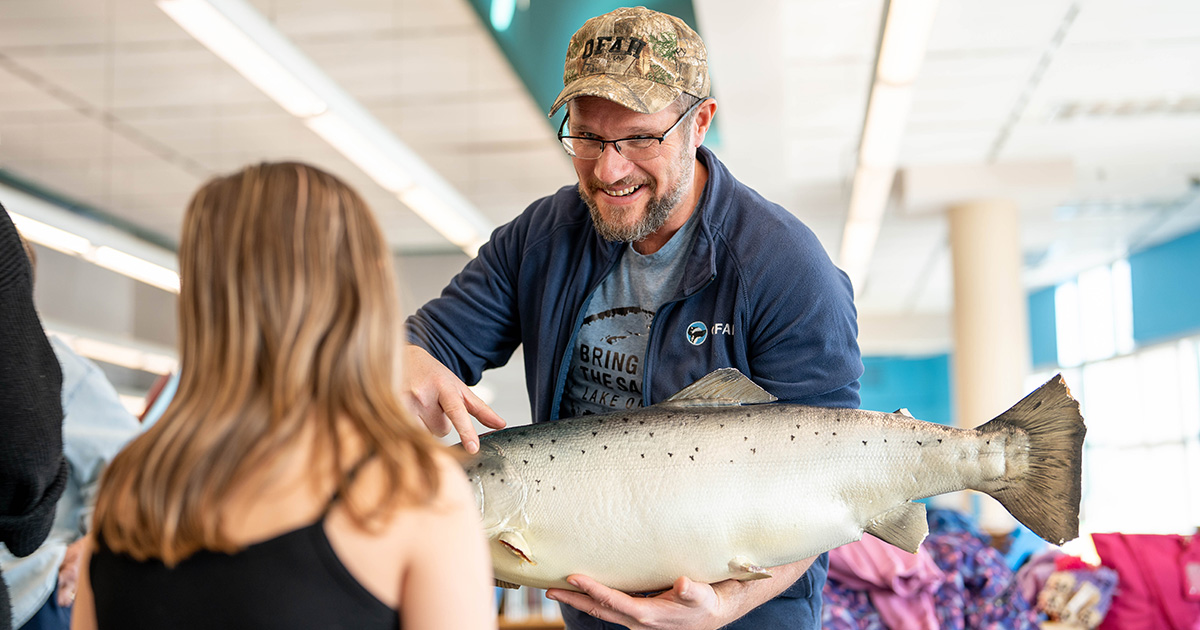
In the late 1980s, I was spending quality time in the town of Nipigon and on the Nipigon River in northwestern Ontario. My girlfriend (now wife), Cheryl, was working at the pool in Nipigon, and I’d visit her whenever I could. While she was at work, I’d pass the time fishing, boating, and exploring the vast, rugged landscape. It was during one of those visits that I firs laid eyes on the mount of the world-record brook trout displayed at the Nipigon Historical Museum. The massive 14.5- pound fish was caught on July 21, 1915, by Dr. J.W. Cook of Fort William. The skin mount was done in the traditional style of the era: one side of the fish’s skin laid over a birch bark backing. By the time I saw it, more than 70 years later, the mount was darkened with age. The spots and vermiculations were faint, but there was no mistaking it — it was a brook trout, and an enormous one. I would visit that fish every chance I got, almost as if on pilgrimage. World record on birchbark postcard. This mount burned in 1990. Fire on the mount Tragically, a fire at the museum in 1990 destroyed the mount. What remains is still on display, but it’s charred and barely recognizable. Though the mount may be gone, the legend of Dr. Cook’s giant fontinalis has only grown with time. When I started spending time in Nipigon in the late ’80s, I met Rob Swainson, a biologist with the Ministry of Natural Resources. Swainson was already working on a recovery plan to help bring the Nipigon brook trout back from the brink. But he was also deeply fascinated by the story of the world-record trout — and, especially after the fire, the long-rumoured existence of a second mount. Swainson’s quest for answers recently came to an extraordinary twist. Splitting a fin “There was an article written in 1916, that said the record trout had been split in half, but one half had been eaten by rats at a photographer’s shop in Fort William,” Swainson shared. “Another later article said that one half was stolen. And there were absolutely no photographs of the right half to be found.” Intrigued, Swainson reached out to Randy Ford, a taxidermist and owner of Walker Downriggers, who had last handled the fish in 1989 before it was displayed at the Sportsmen’s