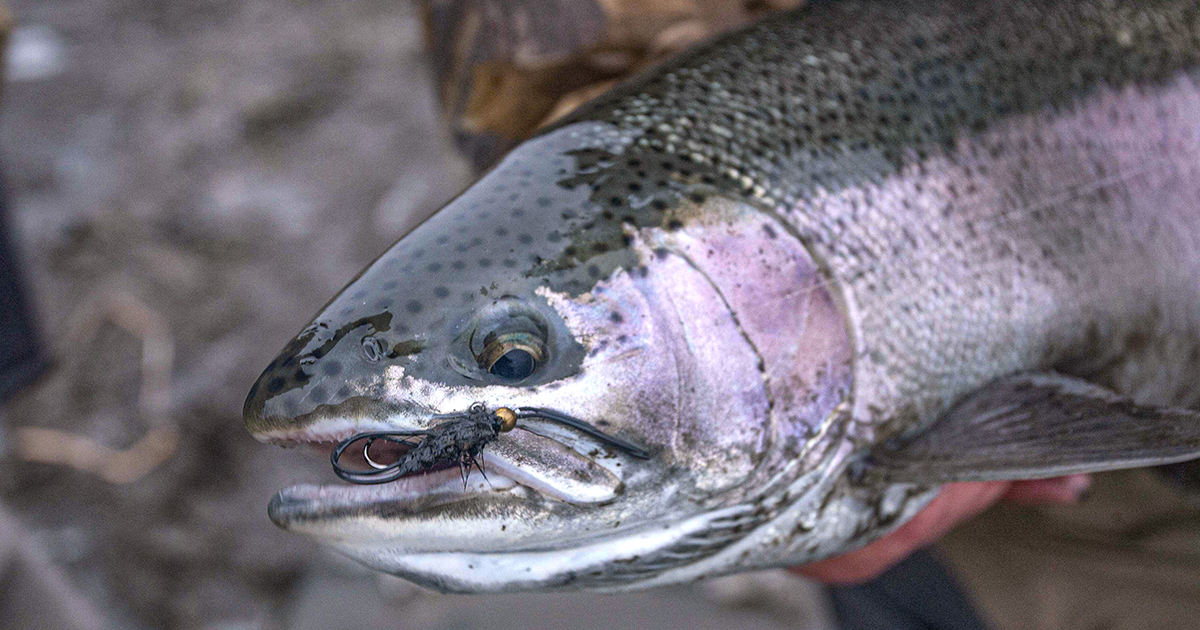
If I had a dollar for every time someone looked in my midge box and asked, “What do you catch with those small hooks?” I could retire. Well, maybe not retire, but you get the picture. Small flies make up most of my fishing on my home waters in southern Ontario, and it’s not out of bravado or my own masochistic tendencies to take fish with the most extreme methods — it’s out of absolute need. Why so small? To survive, trout must weigh their options in terms of caloric intake versus energy expenditure. A grizzly bear will kill and eat a moose. It will also forage for grubs and berries when the need arises. I call this the “Krill Effect.” Why does a blue whale, the largest mammal on the planet, eat krill, a food item that is only a bit larger than a paper clip? Simple, because there are hundreds of thousands of them. Due to the high density of food passing in front it, a trout feeding during a midge hatch only needs to locate a feeding lane, hold there, and move very little to filter in hundreds of chironomids, expending very little energy for tremendous nutritional gain. Rivers in our region, and particularly tailwaters like my home river, the upper Grand, generate an enormous mass of midge larvae and other tiny insects. In the mayfly family we have caenis, aptly nicknamed “Fisherman’s Curse,” tiny blue-winged olives (BWO), and tricos. Along with several different micro caddis, these insects all give anglers a fit when fish are found to be actively feeding to no apparent emergence. Tiny hooks Although the natural “midge” flies that trout feed on can be as small or smaller than a size-24 or -26 hook, my tiny fly patterns are tied on No. 18 to 22 hooks. If you want to go smaller, consider tying a version on a larger hook, like a size-26 body on a 22 hook. The size 22 will give you better hooking and holding than a 26. One trick is to tie a “double”: two flies on one hook, like two size-26 midges on a size 18, back to back. Many small files float in clusters on the water, and having two tightly packed together is no big deal. For those of you who have trouble seeing the hook eye, consider Big Eye Hooks (www.orvis.com), that have eyes between