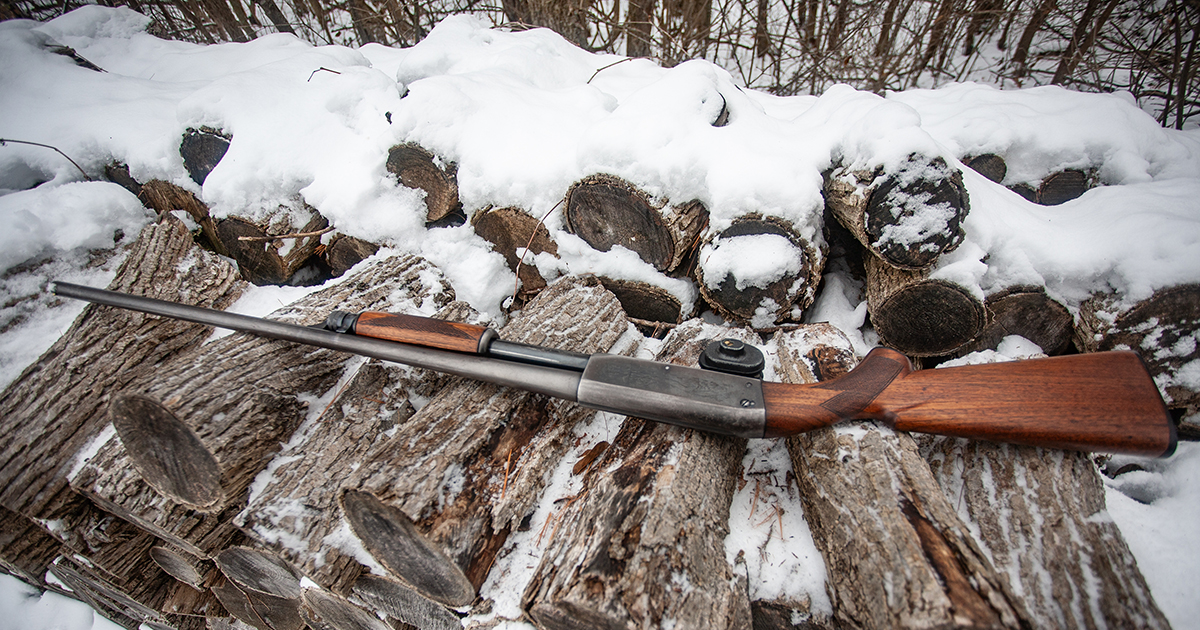
Made: Approximately 8 million produced 1964-present, USAVariants: More than 20 models. Various barrels, 18.5″ standard. Assorted stocks. Mostly .22 LR calibre; also .22 Magnum. Special editions: Canadian Centennial, Boy Scout Commemorative, Ltd. Edition Ruger Collectors Series, 40th, 50th, 60th, and 75th Anniversary, 1976 Liberty Models. Many clones.Original price: $54.50 US, 1964Current value used: $350+; New $430-$690 This 1992 Ruger 10/22 Carbine was my late father-in-law’s favourite .22. He appreciated its compact size and rugged reliability. With it, he dispatched trapped raccoons and coyotes and hunted cottontails. He would not be surprised that this American classic is second only to the Marlin Model 60 as the most popular rimfire rifle ever. The model 10/22 evolved from two iconic rifles. Renowned American firearms innovator, Bill Ruger admired the Second World War US M1 Carbine. He tailored its shape, barrel band, and curved buttplate into his Ruger .44 Magnum Carbine (1961 to 1985). Transforming it into a rimfire, however, proved challenging. Ruger designed a dovetail-like “V-block” to attach the steel barrel to the aluminum receiver with two longitudinal screws. He used his Savage Model 1899/99 experience to craft a 10-shot detachable rotary magazine. Fellow designer, Harry Sefried, created a “decelerator” to sync the bolt’s cyclic rate with the magazine. Sturm & Ruger (Ruger) launched the 10/22 as a “worthy companion” to their .44 Magnum Carbine in 1964. It featured a blow-back semi-automatic action, blued steel barrel and curved rifle style buttplate, black anodized aluminum receiver, trigger group, and barrel band. It also had an American walnut stock with full forend and pistol grip and flush-mounted 10-round detachable rotary magazine. Renamed the 10/22 Carbine in 1965, it remains the most iconic version. Ruger models include Numerous models include: Carbine (1965-present), Fingergroove Sporter (1966-71), Standard Sporter (1971-87), Deluxe Sporter (1980), Sporter (2024), International (1966-69, 1994- 2003), Target (1996- present), Magnum (1999-2006), Target Rifle (2001-02), Rifle (2004-06), Compact (2005-present), Tactical (2010-present), Takedown (2012-present), SR-22 (2013-17), Takedown Lite (2017-present), Takedown Backpacker (2020), Competition (2018-present), Carbine Economy (2019), and 10/22 Charger pistol (2008-19). The 10/22’s modular construction let Ruger reduce production costs to remain competitive. In 1977, they substituted plastic trigger guards, barrel bands, and buttplates, plus birch and synthetic stocks. Fit and finish suffered. Thankfully, the new hammer-forged barrels improved accuracy. Ironically, this modular system also made it very customizable. There are now so many after-market products that you can custom-build a 10/22 to meet any specific