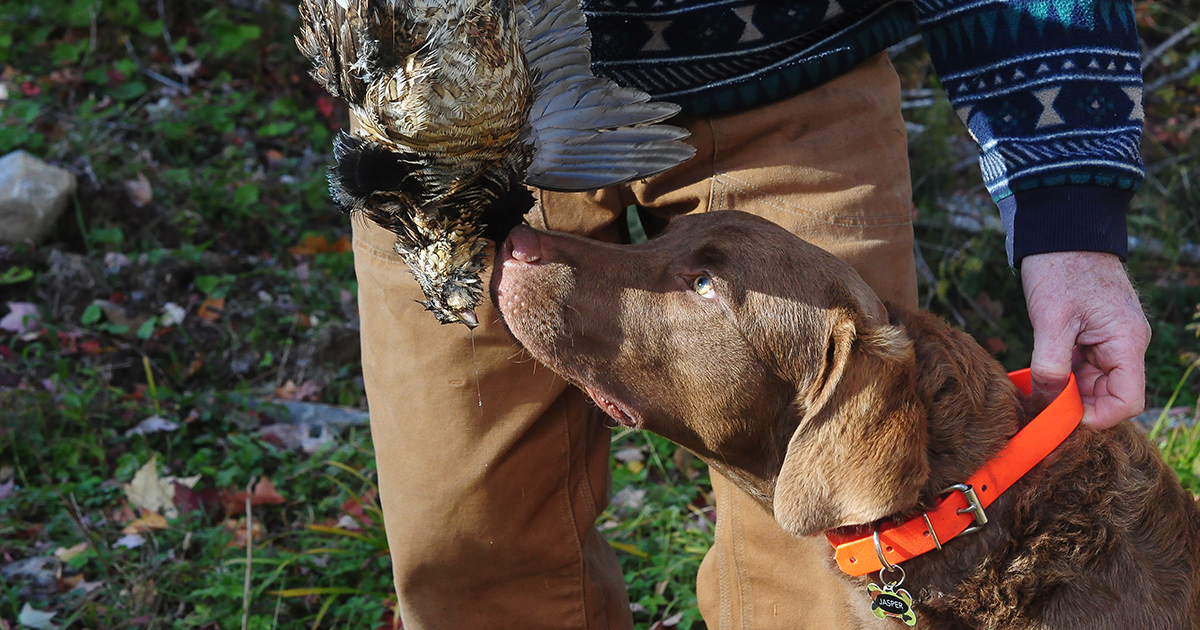
Few things ruin a bird hunt faster than an out-of-control dog. A flushing dog that drives birds out of gun range is often worse than having no dog at all. And a pointing dog that disappears beyond earshot with only a distant bell or beeper for company won’t help you bag a bird — because you won’t know where it’s pointing. A lost dog spoils the hunt for everyone. Both pointing and flushing dogs need to understand they hunt for the gun, not for themselves. Teaching them to quarter at the right distance is essential for a successful hunt. A you problem Out-of-control behaviour is often a human-created problem. Allowing a puppy to free-run on its own teaches it to chase game wherever it pleases for its own amusement. Well-bred bird dogs naturally have strong prey drives and boundless energy. Add a little aloofness, and if the dog ever manages to catch game on its own, good luck convincing it to hunt in partnership with you. It will have learned that the real fun happens far away from you. Never allow a bird dog pup to run loose off-leash or outside a securely fenced area. On the other hand, dogs that stick too close and won’t range out to hunt have a different challenge. It’s usually easier to shorten the range of a hard-charging dog than to motivate a “sticky” one to hunt more boldly. Fortunately, sticky dogs are rare among well-bred bird dogs. Walking your pup Pups need exercise, but it should be structured to encourage them to pay attention to where you are going and to keep track of you. Instead of walking your pup in a straight line on a leash, make frequent, sharp turns while giving two short, loud whistle blasts or a command like “hup.” Let the pup feel a gentle leash correction when it hits the end. If it’s wearing a wide, flat collar, this won’t harm its neck. Over time, the pup will associate the whistle with your change in direction, look to you for guidance, and turn with you — gladly, since it still gets to run. Puppies are like wet cement; every walk is a chance to hardwire good habits into their brains. They can run in front but must keep track of you. Progress to a longer cord Once the pup consistently turns with you on a short leash, repeat