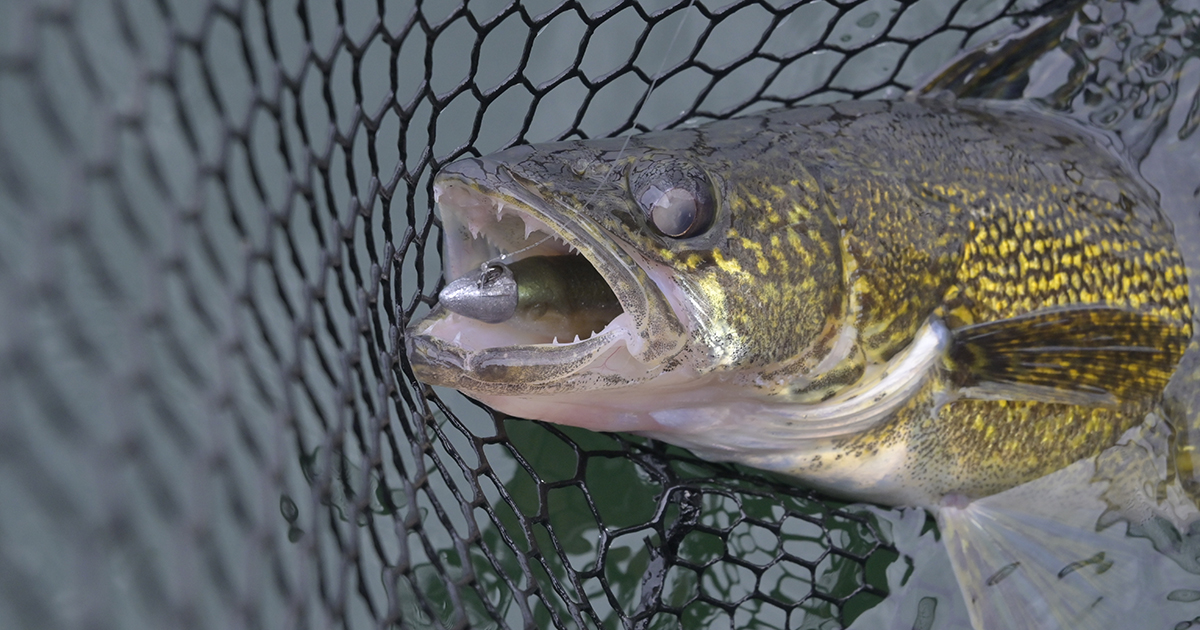
If you're ready to boost your walleye and panfish hooking percentages, you gotta sink to their level. Here's how. Walleye If you were to eavesdrop on anglers' conversations about ice fishing for walleye, I'd wager that the topic of depth would come up almost every time. It's one of the most important aspects of finding walleye in the winter. The first question I ask is, "How deep?" Through experience, I’ve learned that when it comes to depth and winter walleye, deeper can be better. I'd rather know the hot depth than the hot lure — it’s that important to me. One particular day a few winters ago serves as a constant reminder of this. I was out chasing walleye with friends and the morning bite was slow. We were fishing a large, soft-bottomed flat with depths in the mid 20-foot range. We covered ground by hopping holes and caught a handful of walleye, but it was far from spectacular. The lake we were on also has a population of lake trout so we decided to shift gears midday and go after lakers. We moved a few kilometres to a prominent point off a large island in one of the lake’s basins. The crackling of three gas augers made short work of the ice as we drilled a fresh grid of holes around the point. The shallow holes closer to the point were in 35 feet and the holes farthest out were in 90 feet. We spread out and I started close to the point, with my flasher reading 40 feet. I dropped my white tube jig into the hole and watched it spiral downward, out of view. My eyes shifted to my flasher where I watched it descend – 15 feet, 20 feet, 25 feet. When it reached 30 feet a distinct red band appeared on my flasher’s display, rising up from the bottom and intersecting the bait. My line stopped going out and I quickly closed the bail and set the hook. “Got one,” I called out, “it doesn’t feel big though.” It wasn’t big and it wasn’t a lake trout either, rather, a 17-inch walleye. I was surprised to pull a walleye out of 40 feet of water, but even more surprising was repeating this same feat on the next three drops. Four walleye within minutes from 40 feet of water changed the way I think about chasing