For me, roe has been, and will always be, king. If you haven’t caught anything, then maybe there wasn’t much to catch in the first place. That narrow thinking, however, has left me and others walking away from the river disappointed. There are plenty of alternatives to spawn, but here’s one most anglers haven’t tried.
A large stonefly tied on a 90-degree jig hook has been pure gold just as the ice sheets unlock the lower stretches of Great Lakes tributaries. I first saw it in action a decade ago but didn’t clue into its effectiveness until just a few years back.
The discovery
My cousin, his buddy, and I were out to fish my favourite Lake Ontario river (which shall go unnamed) in late February. The water was stained but not murky, and trout were pushing upstream as they do in late winter. The last shards of ice had just released from the lower end of the river, and we were among the first to reach the slow pools near the rivermouth.
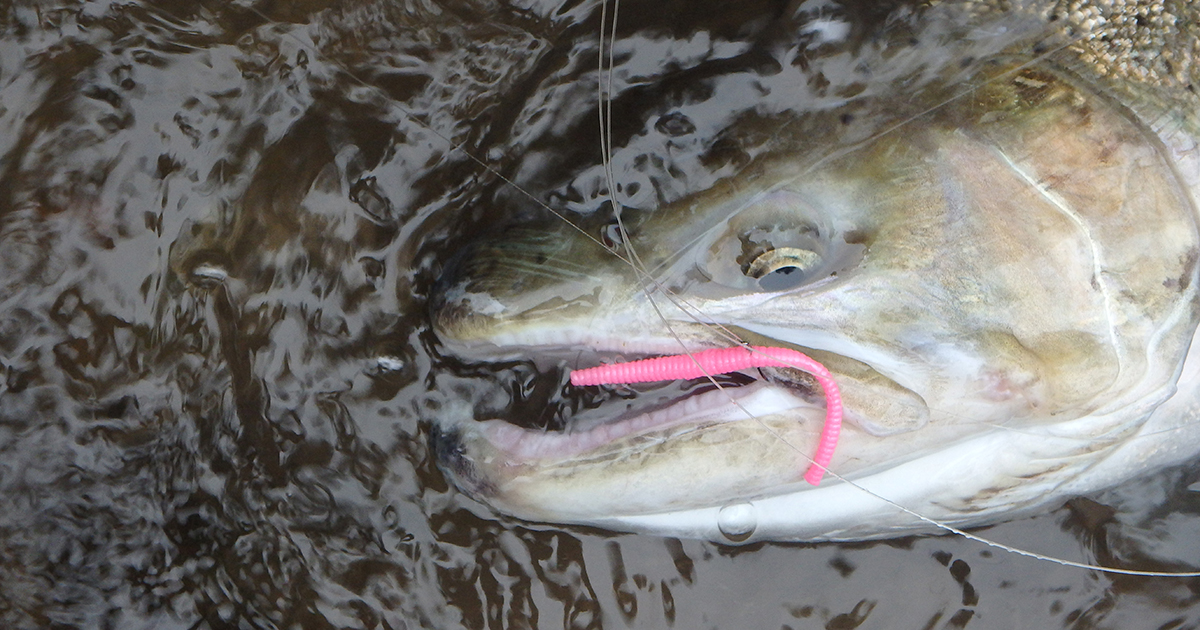
As the morning warmed, I lost hope in the deep pools and decided to chuck my spawn off a nearby Lake Ontario beach, while keeping eye on the closest pools. A group of anglers arrived, drifting their offerings side by side. One guy instantly hooked up, landed and released a silver bullet. By the time I walked back to the long pool, he had landed 10 trout and was feeling the tension from the rest of us who hadn’t had a sniff.
When the bite slowed, he moved upstream, but his secret was out — a large black jig fly below a wide, round float.
Building a theory
When snow blankets the ground and the rivers run open, a winter fly hatch can occur, and trout will feed freely on it. Anglers can capitalize on this hatch with upsized flies.
The pattern
The killer pattern is a large black stonefly tied on a 90-degree jig hook with a tungsten bead head or wrapped with lead. Often called “Jiggy buggers,” some look like stoneflies while others lean more toward woolly buggers — or hybrids that combine both. Flies in the one- to two-inch range seem to draw the most action. The key is ensuring the fly rides horizontally or slightly nose-down, mimicking the natural drift of the hatch. A few strands of living rubber add enticing movement.
A newer twist is tying these patterns directly onto a ball-head jig, typically from 1⁄64 to 1⁄8 ounce. Many anglers prefer a heavier jig that cruises just above bottom, unaffected by subtle undercurrents. Don’t confuse these with west coast twitching jigs, a different animal altogether.
To be clear, these flies are large and heavy in terms of general fly fishing. You’re not tossing bass jigs. Black, brown, and grey, are great, but try other colours, too.
The float
The heavy fly is only half the system. The other is a bulbous float. The theory goes that a chubby float catches more wind, and its wiggle transmits subtle motion to the fly. To counter the float’s buoyancy, anglers add bulk-shot directly beneath it. This keeps the fly sensitive to light takes while allowing it to move freely. When the wind dies, shaking the rod tip can bring the fly to life.
You can replace the fixed float with a sliding one. With two bobber stops — one at the target depth and another just below the float — you can manipulate the fly more easily without disrupting the drift. Slip floats also make casting large set-ups across wide, windswept pools much easier.
This technique leaves plenty of room for experimentation. Just knowing this bite exists should inspire winter steelheaders to drift these big, buggy jigs through their favourite late-winter holes.
Originally published in the Jan.-Feb. 2026 issue of Ontario Out of Doors
For more fly fishing click here
Click here for more outdoors news
Watch on-demand videos anytime on OFAH Stream