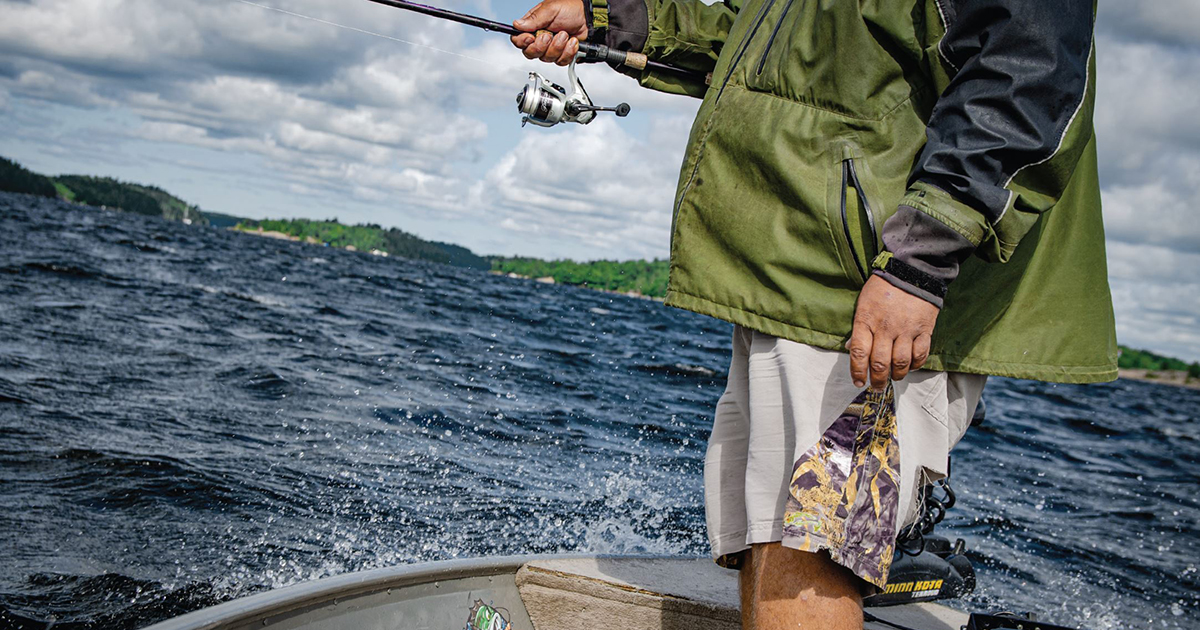
Being at the wrong end of the boat can be embarrassing. Your buddy is hammering walleye in the bow, but youʼre barely scraping up a hit at the stern. Worse still, heʼs normally riding your shirt-tails when it comes to landing walleye. The only difference you can see is that his jig is a shade of orange you donʼt have and, of course, he has only one. An accommodating pike steals his offering just before you go down 10 to 1 for the eveningʼs fishing, but the smug smile on his face remains. Why can colour make a difference some days, when itʼs likely the least important factor in catching walleye at other times? Often thereʼs no clear answer, but general trends can help an angler narrow down the lure colour walleye want on any given day. Light and walleye vision To first understand how walleye react to colours, letʼs look at what colour is and how it behaves underwater. Light is the visible part of the electromagnetic spectrum. At one end of it are radio waves, at the other end are X-rays and gamma rays, and in the middle are visible light rays. Within this band, wavelength decreases and frequency increases from red through yellow, green/ blue, and violet before tapering off into non-visible (to our eye) ultraviolet. White light from the sun or a light bulb contains all the visible light frequencies, which we perceive as white light. When something has a colour, itʼs reflecting one or more parts of the visible light spectrum, while absorbing others. White reflects the most colours of the spectrum and black absorbs the most. This is why black asphalt can become hot enough to cook an egg on under the summer sun. Eyes perceive light waves through the use of specialized rod and cone cells. Rod cells detect black and white contrasts, while cone cells perceive colours. Animals that have a lot of rod cells, such as white-tailed deer, might see colours poorly, but can see light and dark contrasts well. Rod cells are sensitive and come into play in dim light. Animals such as humans, who have plenty of cone cells, but fewer rod cells, can see a wide range of colours, but, without a flashlight, will bash into trees on dark nights. When light hits water When light hits water, a number of things happen. First, some light is reflected