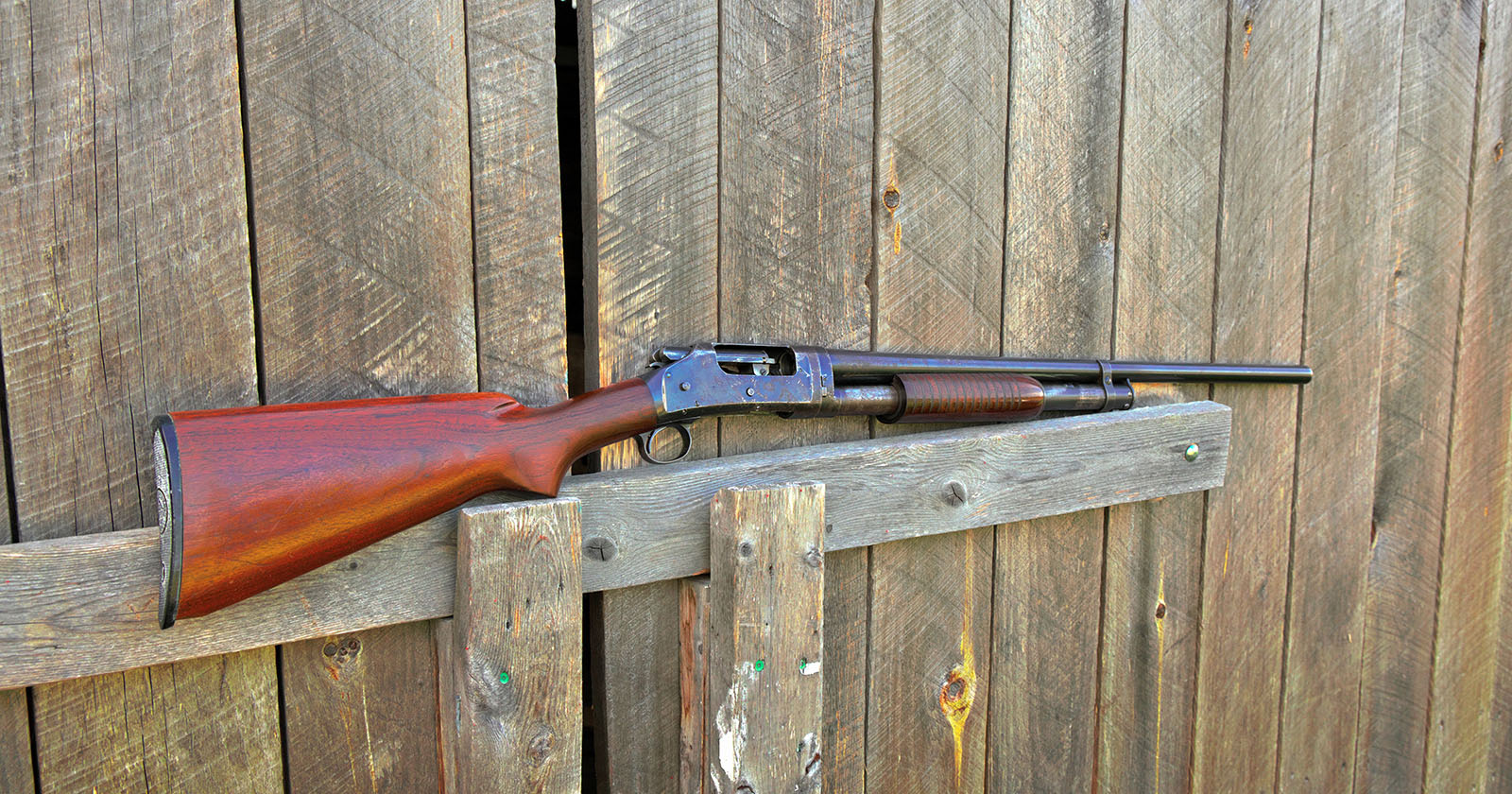
Made: 1937 to 1986, Ithaca NY; 1989-2005, King Ferry NY; 2005-present, Upper Sandusky OH Variants: 12, 16, 20, and 28-gauges; plain, vent, or solid rib barrels 20-32″; models include Featherlight, Skeet, Trap, Deerslayer; police and military versions; several grades and numerous special editions. Model 87 (1987-1996). Production: More than 2 million Original price: $40 US for standard model Current value: Used: $300-400 for 12-gauge standard; $600-plus for 20-gauge; New: 12- or 20-gauge 37 Featherlight $1,199-2,154 US Thanks to bottom loading/ejection, the Model 37 left both sides of the receiver for Ithaca’s iconic engravings. Other standard features include an ambidextrous action release, cross-bolt safety, an interrupted thread on the barrel/receiver for easy takedown, a fluted American walnut stock with chequered grip and cap, and a short , slim chequered forend. The Skeet (37S) and Trap (37T) models sported beavertail forends. Several things attracted me to this 1976 Ithaca Model 37 Featherlight 12-gauge pump-action shotgun. I knew that gunmaker John M. Browning had influenced its design. And, as a “lefty” I liked shells ejecting out the bottom of the receiver instead of flying across my face. I now appreciate its light weight and smooth, reliable action. Ithaca side by sides Several partners, with ties to famed gunmaker L.C. Smith, founded the Ithaca Gun Company in Ithaca, New York in 1883. In 1907, Ithaca acquired Emil Flues’ side-by-side shotgun design. They made more than 223,000 guns from 1908-1926, making it the bestselling American double ever. In 1916, they acquired another classic double manufacturer, the Lefever Arms Company. John M. Browning’s influence Ithaca wanted a pump-action to rival Winchester’s Model 12. They knew that John M. Browning had patented a bottom loading/ejecting pump in 1915. He sold the rights to Remington. Ithaca planned to adopt Browning’s design when his patent expired in 1933. Unfortunately, Pedersen also held a patent until 1936. So, Ithaca’s designer, Harry Howland, simplified the firing pin and ejector before they debuted their refined Model 37 repeater the next year. Refinements made The American government ordered Ithaca to stop making traditional M37s in 1942 so they could focus on M37 trench guns, 1911A1 pistols, and M3 machine guns. When commercial production resumed in 1946, Ithaca simplified the standard forend. They adopted a corn-cob style forend in 1952. Other fifties innovations included the Raybar front sight (1955) and the rifled barrel Deerslayer (1959). Ithaca’s Model 37 proved resilient during troubled times in